
How to negotiate with creditors starts with one simple fact. If you stay silent, your options often shrink. Late fees grow. Rates stay high. Stress builds fast.
If you speak up early, you give yourself a better shot at lower payments, reduced interest, or extra time. Many creditors would rather work out a plan than push an account further behind.
This guide shows you how to negotiate with creditors in a clear, practical way. You’ll learn what to prepare, what to ask for, how to handle the call, and how to protect yourself once a deal is made. If you feel anxious about the process, that makes sense. Still, you do not need a perfect script or expert knowledge. You need your numbers, a realistic offer, and a calm plan you can stick to.
Know What You Owe And What You Can Realistically Offer
Before you call anyone, get your facts straight. This step matters because creditors respond better when you know your balance, your due dates, and the payment you can afford each month. If you guess, you risk agreeing to terms you won’t keep.
Start with a full list of your debts. Include:
- Creditor name
- Account number
- Current balance
- Interest rate
- Minimum payment
- Past due amount
- Due date
- Status, current, late, charged off, or in collections
Next, rank each debt. Put secured debts and essentials first. Then focus on accounts where a quick call might stop fees or prevent further damage.
A simple table helps:
| Account | Balance | Rate | Min Payment | Past Due | Due Date |
|---|---|---|---|---|---|
| Credit card A | $4,200 | 27% | $140 | $280 | 18th |
| Personal loan | $7,500 | 15% | $220 | $0 | 25th |
| Medical bill | $1,100 | 0% | $75 | $75 | 10th |
Once you see the full picture, choose a monthly amount you can offer without missing rent, food, utilities, insurance, or car costs. Be strict here. A smaller payment you keep is better than a promise you break.
Gather Account Details, Due Dates, Hardship Proof, And A Simple Budget
Now collect the documents you’ll need during the call. Keep them in one folder, paper or digital, so you do not scramble while talking.
Useful items include:
- Recent statements
- Letters or emails from the creditor
- Proof of income
- Proof of hardship, such as job loss, reduced hours, medical bills, or divorce papers
- A one page budget
- Notes on prior calls
Your budget does not need fancy software. Write down your monthly take home pay, then list fixed costs and basic living costs. The goal is to show what is left for debt payments.
Example:
- Income, $3,200
- Rent, $1,100
- Utilities, $220
- Groceries, $450
- Car and gas, $380
- Insurance, $190
- Phone and internet, $120
- Other essentials, $240
- Amount left for debt, $500
If you have five creditors and only $500 available, your offers must fit inside that limit. This is the core of how to negotiate with creditors. You are not asking for random relief. You are presenting a payment plan based on real numbers.
Understand Your Options Before You Call
You’ll negotiate better when you know the outcomes you want. Many people call and ask for “help” without naming a exact solution. That puts control in the creditor’s hands.
Instead, learn the main types of relief first. Then pick the one that best fits your situation. If your income dropped for a short period, you might need temporary relief. If the debt is old and you have some cash saved, a settlement might make more sense.
Common options include:
- Lower interest rate
- Waived late fees
- Temporary reduced payment
- Long term payment plan
- Hardship program
- Forbearance or payment pause
- Lump sum settlement for less than the full balance
- New due date aligned with your payday
When you know what to ask for, the call gets easier. You sound prepared. You also avoid accepting a deal that helps the creditor more than you.
Compare Lower Interest, Payment Plans, Forbearance, And Lump-Sum Settlements
Each option works differently. Choose based on your debt type, how late you are, and how much money you have right now.
Lower interest rate works best when your account is still open and not far behind. Even a drop from 29% to 12% cuts the total cost over time. Ask for this if you can still make monthly payments but need breathing room.
Payment plans spread what you owe across fixed monthly amounts. This option helps when you need structure and a set end date. Always ask how long the plan lasts and whether interest still applies.
Forbearance gives you a short pause or smaller payments for a limited time. This is common after job loss, illness, or another hardship. Ask what happens after the pause ends. Some creditors add skipped payments to the back of the loan. Others expect a larger payment later.
Lump sum settlements mean you pay less than the full balance in one payment or a few payments. This often comes up on charged off accounts or collection accounts. For example, if you owe $5,000, a creditor might accept $2,500 to $3,500. The older the debt, the more room there often is. Still, ask how the account will be reported to credit bureaus before you agree.
A quick comparison helps:
| Option | Best for | Main benefit | Main risk |
|---|---|---|---|
| Lower interest | You can still pay monthly | Reduces cost | Payment might stay high |
| Payment plan | Steady income, tight budget | Predictable payments | Longer payoff |
| Forbearance | Short term hardship | Immediate relief | Bigger issue later |
| Settlement | You have cash, account is delinquent | Pay less overall | Credit impact, tax issues |
This step is a major part of how to negotiate with creditors because your best result depends on asking for the right form of relief.
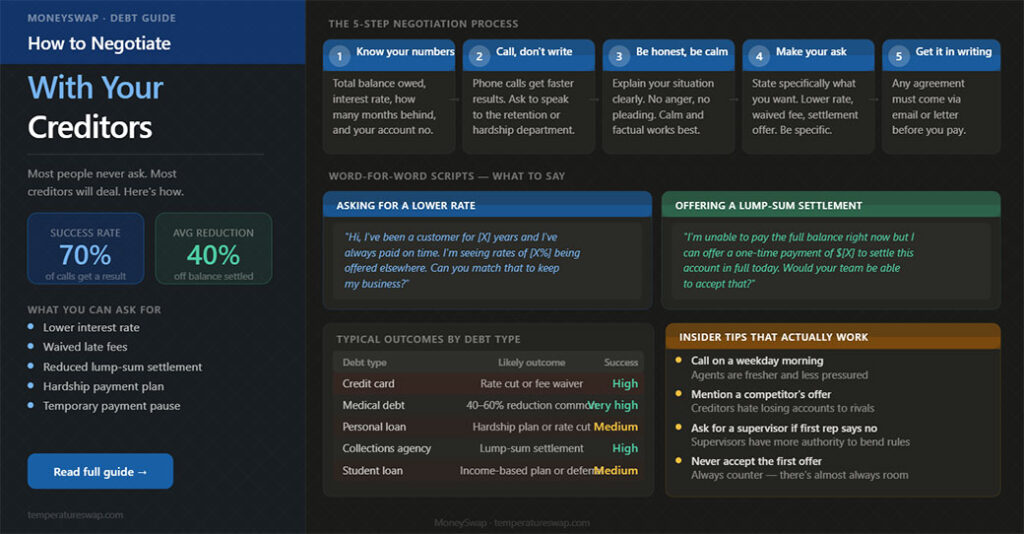
Call Your Creditors And Negotiate With A Clear Script
Once your numbers are ready, make the call. Earlier is better. Creditors tend to offer more options before the account gets worse.
Call the customer service or hardship department first. If the first person cannot help, ask for a supervisor or the department that handles payment arrangements. Stay calm. Stay polite. Be direct.
Use a simple script like this:
“Hi, I’m calling about my account because I’m dealing with a financial hardship. My income changed, and I want to avoid falling further behind. I reviewed my budget and I can pay $125 per month starting this month. Are there hardship options, lower interest options, or a payment plan available?”
If you want a settlement, say:
“I want to resolve this account. I have a limited amount available. If you can accept $1,800 as settlement in full, I’m prepared to pay by the 30th once I receive the agreement in writing.”
Then stop talking. Let them respond.
During the call:
- Write down the date, time, and agent name
- Ask what programs are available
- Repeat your offer clearly
- Ask about fees, interest, and reporting to credit bureaus
- Ask whether autopay is required
- Ask for written terms before sending money
If they reject your first offer, do not panic. Try a smaller step. For example:
- Ask for a lower rate first
n- Ask to move the due date
- Ask for fees to be removed
- Ask for a three month hardship plan
- Ask if a supervisor has more flexibility
You should also expect some pushback. A collector or agent might ask for more than your budget allows. Do not agree on the spot if the number does not work. Say, “That amount does not fit my budget. The most I can commit to is $125.”
Silence helps here. So does repetition.
If you’re negotiating with a debt collector, be extra careful. Confirm the debt belongs to you and ask for validation if needed. Do not share bank access during the first call. Also, avoid paying from fear. Pay only after you understand the terms.
How to negotiate with creditors gets easier when you treat the call like a business conversation. You are there to solve a payment problem with facts and a exact proposal.
Get Every Agreement In Writing And Follow Through
A verbal promise is not enough. If the terms are not in writing, you have little proof later. This step protects you from billing errors, bad reporting, and surprise collection activity.
Before you pay anything, ask for written confirmation that includes:
- Your name and account number
- The exact amount due
- Payment dates
- Interest rate, if changed
- Whether fees are waived
- Whether the payment satisfies the account in full, if settled
- How the account will be reported to credit bureaus
- What happens if one payment is late
Read every line. If something looks vague, call back and ask for correction.
For settlements, the phrase matters. You want language such as “settled in full” or “account will be considered satisfied.” If the letter does not clearly state that your payment resolves the debt, do not send funds yet.
After you pay, keep records forever, or at least for several years. Save:
- Agreement letters
- Payment receipts
- Bank confirmations
- Screenshots of online payments
- Notes from calls
Then monitor the account. Check your statements and your credit reports to see if the creditor follows the agreement. You can get free weekly credit reports from AnnualCreditReport.com.
If the reporting is wrong, dispute it with both the creditor and the credit bureau. Attach your written agreement and proof of payment.
Following through also means making payments on time. Set reminders a few days before each due date. If your hardship changes again, call before you miss the next payment. Waiting creates more damage and fewer options.
This part of how to negotiate with creditors is less dramatic than the phone call, yet it often decides whether your deal helps or hurts you in the long run.
Avoid Common Mistakes And Know When To Get Professional Help
A few mistakes can erase a good deal. Others can put you in a worse spot than before. If you know the common traps, you’ll protect your money and your credit.
Mistakes to avoid:
- Offering a payment before you review your budget
- Agreeing to automatic withdrawals you cannot control
- Sending money before getting written terms
- Ignoring tax effects on forgiven debt
- Assuming every collector owns the debt legally
- Choosing one debt while missing rent, utilities, or food
- Letting fear rush your decision
Watch the tax issue with settlements. If a creditor forgives $600 or more, you might receive a 1099 C form. In some cases, you may owe tax on the forgiven amount. The IRS explains the rules on cancelled debt at IRS.gov.
You should also know when to call in help. If your debt is spread across many accounts, if collectors are suing you, or if you cannot tell which debts to pay first, outside guidance helps.
Good options include:
- A nonprofit credit counseling agency
- A consumer law attorney if you face a lawsuit or harassment
- A bankruptcy attorney if your total debt is beyond what you can repay
Look for reputable counselors through the National Foundation for Credit Counseling or the Financial Counseling Association of America.
Be cautious with debt settlement companies that demand large upfront fees or promise a fixed result. Ask what they charge, how long the process takes, and what happens if creditors refuse to settle.
How to negotiate with creditors does not mean you must handle every case alone. If the numbers do not work, professional help may save time, money, and stress.
Recap Your Plan And Take The Next Step Today
How to negotiate with creditors comes down to a short plan. Know your balances. Build a simple budget. Choose the relief you want. Call with a clear offer. Get the deal in writing. Then track every payment and every update to your account.
Start with one creditor today, not all of them at once. Print your statements, write your script, and make the first call while your numbers are fresh. If the answer is no, try again with a different option or a supervisor.
Progress often starts with one honest conversation. The sooner you begin, the more choices you tend to have. Your goal is not a perfect deal. Your goal is a deal you can afford and keep.
Frequently Asked Questions about Negotiating with Creditors
What is the first step to take when negotiating with creditors?
The first step is to know exactly what you owe and determine a realistic monthly payment you can afford without missing essential expenses. This includes listing debts, balances, interest rates, and due dates to prepare an informed offer.
How can I prepare for a call with a creditor to negotiate my debt?
Gather recent statements, proof of income, hardship documents, and a simple budget that shows your income and expenses. Use a clear script that states your financial hardship and a specific payment offer, then ask about available hardship programs or payment plans.
What are common options to request when negotiating with creditors?
You can ask for lower interest rates, waived late fees, temporary reduced payments, long-term payment plans, hardship programs, forbearance periods, or lump-sum settlements for less than the full balance depending on your situation.
How should I handle agreements made with creditors during negotiations?
Always get every agreement in writing before making payments. Written confirmation should include payment amounts, due dates, any changed interest rates, waived fees, and how the account will be reported to credit bureaus to protect yourself.
Can negotiating with creditors affect my credit score?
Yes, options like settlements or forbearance may impact your credit report. Before agreeing, ask how the creditor will report the arrangement to credit bureaus, so you understand potential effects on your credit score.
When should I seek professional help for negotiating debts?
If your debts are numerous or complex, if collectors are suing you, or if you cannot prioritize payments, consider help from nonprofit credit counselors or consumer law attorneys to protect your rights and find manageable solutions.
