
A lot of people assume investing is something you do later, after you have “real money,” a big paycheck, or a few thousand dollars sitting around. That myth keeps beginners stuck. The truth is, you can absolutely start investing with $100.
Thanks to fractional shares, low-cost brokerages, and simple ETFs for beginners, the barrier to entry is much lower than it used to be. You no longer need enough cash to buy a full share of an expensive stock or hire an advisor to get going. If you have $100 and a willingness to learn, you have enough to begin.
That doesn’t mean every dollar should go straight into the market, though. If your rent is due next week, your credit card is charging 25% interest, or you have no emergency cushion at all, there may be a smarter first move. Good beginner investing isn’t about chasing excitement. It’s about making steady decisions that fit your life.
In this guide, you’ll learn the best ways to invest $100, when it makes sense to choose a safer option like a high-yield savings account, how to avoid common small-dollar mistakes, and what happens if you keep going by investing $100 every month. You’ll also see sample plans for conservative, balanced, and growth-focused beginners so you can stop wondering and start taking action.
Can You Really Start Investing With Just $100?
Yes, you really can.
If you’re wondering whether $100 is enough to make investing worthwhile, the honest answer is this: $100 by itself probably won’t change your life overnight, but the habit it starts can. That’s the part many beginners miss. Investing is less about the size of your first deposit and more about building a repeatable system.
A few years ago, learning how to invest 100 dollars was more limiting. Many brokerage accounts had higher minimums, and if you wanted to buy shares of well-known companies, you often had to afford one full share. Today, many platforms let you buy fractional shares, which means you can invest in companies or funds with just a few dollars.
That opens up real choices:
- You can buy part of an ETF that gives you instant diversification.
- You can purchase a slice of a company stock.
- You can use micro-investing apps to automate tiny contributions.
- You can keep your money in a high-yield savings account if safety matters more right now.
So yes, you can start investing with $100. But there’s an important distinction: not every person with $100 is ready to invest that $100 in the stock market today.
Why this matters: if you invest without a basic safety plan, you may end up pulling the money out at the worst possible time. That turns a smart long-term move into a stressful short-term mistake.
A better beginner mindset is this:
- Make sure the money is truly available.
- Pick an option that matches your risk tolerance.
- Keep fees low.
- Think in years, not days.
- Add money consistently when you can.
If your goal is to learn, build momentum, and create a habit of monthly investing, then $100 is more than enough to begin. In fact, starting small can be an advantage. You get to learn how markets work, how your emotions react, and how to stay consistent, without risking a huge amount of money.
And that’s a strong place to start.
Before You Invest: 3 Things to Do First
Before you pick stocks, download an app, or buy your first ETF, take a quick step back. The best beginner investing decision is often made before you invest.
These three steps can protect you from using your $100 in a way that creates more stress than progress.
Build a Small Emergency Fund
This comes first for a reason.
If you have no emergency cushion at all, your first $100 may be better used as the start of a mini safety net rather than a market investment. That might not sound exciting, but it’s practical, and practical wins.
An emergency fund helps cover surprise expenses like:
- a car repair
- an urgent prescription
- a utility bill spike
- replacing a broken phone you need for work
Without that cushion, you could be forced to sell investments early or rely on a credit card when life happens. That’s especially risky if the market is down at the same time.
You don’t need a fully built 3–6 month emergency fund before you ever invest a dollar. For many beginners, a good first goal is $500 to $1,000 in accessible cash. A high-yield savings account is often the best place for that money because it stays liquid and earns more interest than a traditional savings account.
A simple rule of thumb:
- No emergency savings at all? Consider putting the full $100 into savings first.
- Small emergency cushion already in place? You may be ready to split money between saving and investing.
- Stable budget and basic cash buffer? You can more confidently invest the $100.
Think of your emergency fund as the foundation. Investing works better when you’re not one surprise expense away from cashing out.
Pay Off High-Interest Debt
If you’re carrying high-interest debt, especially credit card debt, paying that down may give you a better guaranteed return than investing.
Here’s why.
If your credit card charges 22% APR, and you use $100 to reduce that balance, you’re effectively avoiding a very expensive interest cost. Compare that to long-term stock market returns, which are positive on average over time but not guaranteed in the short term.
For example:
- Paying off debt at 22% interest is like earning a risk-free 22% benefit on that money.
- Investing in the market might earn more over many years, but it could also drop next month.
That doesn’t mean you must eliminate every debt before investing. Low-interest student loans or manageable fixed-rate debt are different from revolving, high-interest balances.
A beginner-friendly order often looks like this:
- Cover essentials.
- Build a small emergency buffer.
- Attack high-interest debt.
- Start investing consistently.
If you want motivation, you can still put a tiny amount, say $10 or $20, into an investment account while using the rest to pay debt. That can help you build the habit without ignoring the math.
But if you’re choosing between paying down a 25% credit card and buying a trendy stock, the debt payoff is usually the smarter move.
Define Your Investment Goals
Once your basics are covered, the next step is knowing what this $100 is for.
That question matters because the best ways to invest $100 depend on your timeline and purpose. The right choice for a long-term goal isn’t always the right choice for money you may need in six months.
Ask yourself:
- Is this money for long-term wealth building?
- Are you mostly trying to learn how investing works?
- Do you want safety more than growth?
- Might you need this money within 1–3 years?
A quick guide:
- Goal: Learn and start investing → A broad-market ETF or fractional share purchase can make sense.
- Goal: Keep money safe for near-term use → A high-yield savings account may be better.
- Goal: Improve future earning power → Investing in yourself could be the highest-return move.
It also helps to define your time horizon:
| Time horizon | Better fit |
|---|---|
| Less than 1 year | High-yield savings account |
| 1–3 years | Usually savings or very cautious investing |
| 5+ years | ETFs, diversified stock investing |
| 10+ years | Growth-focused investing becomes more realistic |
Clear goals prevent random decisions. And random decisions are one of the fastest ways beginners lose confidence.
When you know your goal, your $100 stops feeling small. It starts feeling intentional.
Best Ways to Invest $100
When beginners ask for the best ways to invest $100, they’re usually asking two different questions at once:
- What could help my money grow?
- What’s least likely to blow up in my face?
The good news is you have several solid options. The right one depends on your goals, timeline, and comfort with risk.
Invest in an ETF
If you want one of the simplest, strongest beginner choices, start here.
An ETF, short for exchange-traded fund, is a basket of investments you can buy in one purchase. Instead of betting your entire $100 on one company, you can own small pieces of many companies at once. That diversification is a big reason ETFs for beginners are so often recommended.
For example, a broad-market ETF might include hundreds or even thousands of stocks. That means your results don’t depend on one company having a great year.
Why it matters:
- Lower risk than a single stock because your money is spread out
- Simple to understand once you know the basics
- Low maintenance compared with researching individual companies
- Often low cost, especially for index ETFs
A strong beginner approach is to look for:
- broad U.S. stock market ETFs
- S&P 500 ETFs
- total market ETFs
- low expense ratios
With fractional shares, you don’t need enough money to buy a full share. You can often invest the exact $100.
Best for:
- beginners who want long-term growth
- people who don’t want to pick individual stocks
- anyone building a simple, repeatable strategy
Watch out for:
- short-term market drops
- buying sector ETFs you don’t understand
- trading too often
If you’re unsure where to begin, a low-cost diversified ETF is often the cleanest answer to how to invest 100 dollars wisely.
Buy Fractional Shares
Fractional shares make small-dollar investing possible in a way that simply didn’t exist for many investors in the past.
A fractional share means you buy a portion of a stock instead of a whole share. So if a company’s stock costs $500 per share, you may still be able to invest $25 or $50 in it.
This matters because it removes a huge mental barrier. You no longer need thousands of dollars to access well-known companies or diversified funds.
Why beginners like this option:
- You can start with very little money.
- You can spread your $100 across several holdings.
- You can test the investing process without a large commitment.
Example:
You could split $100 like this:
- $60 into a broad-market ETF
- $20 into a large established company
- $20 into another company or ETF
That said, just because you can buy fractional shares of individual companies doesn’t mean you should build a mini portfolio of random popular names. Small-dollar investing can tempt you to buy whatever is trending because the dollar amounts feel harmless.
A better use of fractional shares is often:
- buying into diversified ETFs
- gradually building positions in quality investments
- automating recurring purchases
Best for:
- beginners using modern brokerages
- people who want flexibility with small amounts
- investors who want to combine ETFs and individual stocks
Watch out for:
- overcomplicating your first $100
- buying too many tiny positions
- confusing accessibility with quality
Fractional shares are a tool, not a strategy. Use them to make a good plan easier, not to make speculation feel safer than it is.
Use a Micro-Investing App
If your biggest challenge is consistency, micro-investing apps can help.
These platforms are designed to make investing feel easy and automatic. Some let you start with a few dollars, round up your purchases, or set recurring deposits into a diversified portfolio.
Why this matters for beginners:
- automation removes friction
- small deposits feel manageable
- simple interfaces make investing less intimidating
For someone who keeps saying, “I’ll invest when I have more,” a micro-investing app can turn intention into action. And action matters more than perfection early on.
Typical features include:
- automatic deposits
- round-ups from debit card purchases
- prebuilt portfolios
- educational tools
But here’s the caution: with only $100, fees matter a lot. A monthly platform fee can eat a noticeable chunk of your returns if your balance is tiny.
For example, if an app charges $3 per month, that’s $36 per year. On a $100 starting balance, that’s a major drag unless you’re contributing regularly and getting meaningful value from the service.
Best for:
- beginners who need automation
- people who struggle to stay consistent
- investors who want a simple all-in-one experience
Watch out for:
- monthly subscription fees
- portfolios you don’t understand
- assuming “easy” always means “best value”
A micro-investing app can be a great launchpad, especially if it gets you investing every month. Just make sure convenience isn’t quietly costing you too much.
Invest in Dividend Stocks
Dividend stocks are shares of companies that pay part of their profits to shareholders, usually on a regular schedule. For beginners, that can sound appealing because you’re not only hoping the stock price rises, you may also receive cash payments along the way.
That said, dividend investing is often oversimplified online.
Yes, dividends can be useful. They can provide income, signal that a company is established, and support long-term compounding if you reinvest them. But a dividend stock is still a stock. Its price can fall, the dividend can be reduced, and a high yield can sometimes be a warning sign rather than a gift.
Why some beginners choose dividend stocks:
- they like the idea of visible cash payouts
- established dividend payers can feel more stable
- reinvested dividends can support long-term growth
With only $100, the actual dividend payments will usually be small. Very small. So this option makes more sense as a learning tool or as part of a broader long-term plan than as a source of immediate income.
A smarter beginner approach is to focus on:
- financially strong, established companies
- dividend ETFs rather than a single stock, if you want more diversification
- total return, not just yield
Best for:
- beginners interested in long-term reinvesting
- people who like steady, established businesses
- investors who want a middle ground between growth and income
Watch out for:
- chasing the highest yield
- treating dividends as guaranteed
- sacrificing diversification for the “income” idea
Dividend stocks can play a role, but they’re usually not the first or only answer for a brand-new investor with $100.
Invest in a High-Yield Savings Account
This is not a stock market investment, but it may still be one of the best uses of your $100.
A high-yield savings account keeps your money accessible while earning more interest than a typical savings account. For beginners who are nervous, saving for a near-term goal, or still building a financial cushion, this can be the smartest first move.
Why it matters:
- your balance doesn’t swing with the market
- your money stays liquid
- you earn interest while keeping risk very low
- it supports your overall financial readiness
This option is especially strong if:
- you don’t yet have an emergency fund
- you may need the money within a year or two
- you’re paying down debt and want cash flexibility
- you’re not emotionally ready for market ups and downs
Will a high-yield savings account make you rich? No. But not every financial choice needs to maximize return. Sometimes the job is to protect your stability.
Best for:
- short-term goals
- emergency savings
- cautious beginners
- people deciding whether to invest now or later
Watch out for:
- expecting stock-like returns
- leaving long-term money in cash forever
- choosing an account with restrictions or low rates
If you’re asking for the safest way to invest $100, this is usually the closest practical answer, even though technically it’s saving more than investing.
Invest in Yourself
This option is underrated, and for some beginners, it offers the highest payoff.
Investing in yourself means using that $100 to increase your future earning power, skills, health, or career opportunities. That could mean buying a course, paying for a certification exam, upgrading a work tool, purchasing books, or learning a marketable skill.
Examples include:
- a beginner Excel, design, or coding course
- a résumé review or portfolio improvement
- materials for a side hustle
- books on personal finance or investing
- equipment that helps you earn more
Why this matters:
If a $100 investment in yourself helps you earn even $50 more per month, the long-term return could beat what that same $100 might do in the market over the short run.
Best for:
- people early in their careers
- anyone trying to increase income
- beginners who need more financial capacity before aggressive investing
Watch out for:
- buying courses you won’t finish
- calling random spending “self-investment”
- choosing inspiration over actual skill building
A helpful test: ask, “Will this likely improve my income, knowledge, or decision-making within the next year?” If yes, it may be a very smart use of your first $100.
Not every good financial move has a ticker symbol.
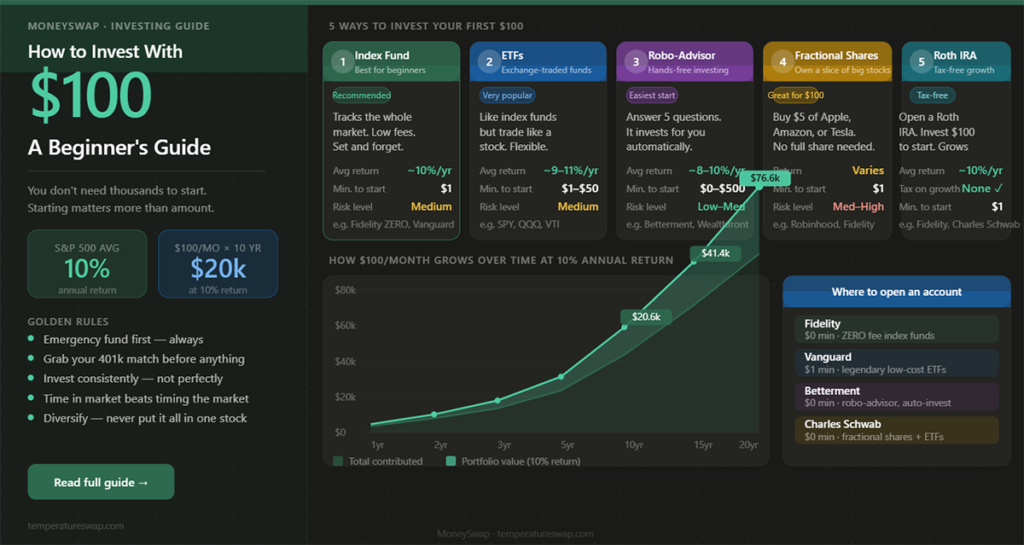
What Happens if You Invest $100 Every Month?
This is where things get interesting.
A single $100 investment is a start. But monthly investing is where small amounts begin to create real results through compound growth.
Compound growth means your money can start earning returns on past returns, not just on your original contributions. It’s not magic. It’s just time doing the heavy lifting.
Let’s keep expectations realistic.
No return is guaranteed, and markets move unpredictably in the short term. But for long-term illustration, it’s reasonable to look at sample annual returns like 4%, 7%, and 10% to understand the range.
If you invest $100 every month, here’s roughly what that could grow to:
| Time invested | At 4% annual return | At 7% annual return | At 10% annual return |
|---|---|---|---|
| 5 years | about $6,630 | about $7,200 | about $7,750 |
| 10 years | about $14,700 | about $17,400 | about $20,500 |
| 20 years | about $36,700 | about $52,400 | about $76,000 |
| 30 years | about $69,400 | about $121,900 | about $226,000 |
Your total contributions after 30 years would be $36,000. The rest would come from growth.
That’s the key mindset shift: small monthly amounts can snowball when you give them enough time.
Here are three simple scenarios:
Scenario 1: You start now and stay consistent
You invest $100 per month into a diversified ETF portfolio and keep going for 20 years. Even with moderate returns, you could build tens of thousands of dollars.
Scenario 2: You wait five years to begin
You tell yourself you’ll start when you earn more. But those missing years matter. You don’t just lose contributions, you lose years of compounding.
Scenario 3: You increase contributions later
You begin with $100 per month now, then raise it to $150 or $200 when your income grows. This is often how beginner investing becomes serious wealth building.
A few practical tips:
- automate your monthly deposit
- increase contributions after raises
- don’t stop because the amount feels “too small”
- ignore short-term market noise if your timeline is long
If you’re wondering whether $100 is enough to matter, the better question is: Can you keep going? Because consistency beats a one-time burst almost every time.
Comparison Table: Best Ways to Invest $100
Here’s a quick side-by-side view to help you choose based on risk, return, beginner friendliness, and time commitment.
| Option | Risk | Potential return | Beginner friendliness | Time commitment |
|---|---|---|---|---|
| Broad-market ETF | Moderate | Moderate to high over long term | Very high | Low |
| Fractional shares of individual stocks | Moderate to high | Moderate to high, but less predictable | Medium | Medium |
| Micro-investing app | Depends on portfolio and fees | Low to moderate or moderate to high | High | Low |
| Dividend stocks | Moderate | Moderate, with possible income | Medium | Medium |
| High-yield savings account | Very low | Low | Very high | Very low |
| Invest in yourself | Varies | Potentially very high | High | Medium |
Here’s a faster way to think about it:
- Best all-around beginner option: broad-market ETF
- Best for safety: high-yield savings account
- Best for accessibility and flexibility: fractional shares
- Best for automation: micro-investing app
- Best for income-minded learners: dividend stocks
- Best for boosting future earnings: invest in yourself
If you want the shortest answer possible:
- choose a high-yield savings account if you need safety or short-term access
- choose a low-cost ETF if you want long-term growth
- choose self-investment if increasing your income is the real priority right now
There isn’t one universal winner. The best option is the one that matches what your $100 needs to do for you.
Common Mistakes to Avoid When Investing With $100
When your starting amount is small, mistakes matter more, not because they’ll bankrupt you, but because they can derail your habit and confidence early.
Chasing Hot Stocks
This is one of the fastest ways beginners turn investing into gambling.
When you only have $100, it’s tempting to think you need a huge winner to make the effort worthwhile. So you buy whatever stock is exploding on social media, making headlines, or being hyped as “the next big thing.”
The problem? By the time a stock feels exciting to everyone else, the easy gains may already be gone. And highly hyped stocks can fall just as quickly.
A better approach:
- use most of your money for diversified investments like ETFs
- keep any “fun money” portion very small
- never buy something you can’t explain in one sentence
If your plan depends on one stock doubling fast, you don’t really have an investment plan. You have a hope-and-scroll strategy.
Trying to Get Rich Quickly
Small-dollar investing works best when you stop expecting immediate results.
Your first $100 is not supposed to become $10,000 in a month. Could $100 turn into $1,000 someday? Yes, but usually through time, consistent contributions, smart allocation, and a little patience. Not through miracle trades.
The danger of quick-rich thinking is that it pushes you toward:
- speculative stocks
- crypto you don’t understand
- frequent trading
- risky options strategies
- emotional decisions after losses
Instead, treat your first $100 as the beginning of a process:
- learn the mechanics
- build confidence
- automate contributions
- stay invested long enough for compounding to matter
Boring is underrated. Boring is often profitable.
Ignoring Fees
With a large portfolio, a small fee can be annoying. With $100, it can be brutal.
Fees are one of the most important things to watch in beginner investing, especially when using apps, funds, or platforms aimed at new investors.
Common costs to check:
- monthly platform fees
- fund expense ratios
- account transfer fees
- trading spreads or hidden costs
Example:
If you invest $100 and pay a $5 fee, that’s 5% gone immediately. You’d need gains just to get back to even.
Look for:
- no account minimums or low minimums
- low-cost index ETFs
- no unnecessary subscription charges
- clear, easy-to-understand pricing
This doesn’t mean every paid tool is bad. But the value must be worth it.
A simple rule: when your balance is small, prioritize low-cost platforms and uncomplicated investments.
Investing Money You Need Soon
This mistake hurts because it often forces bad timing.
If you invest money that you may need for rent, bills, travel, tuition, or emergencies in the next few months, you might have to sell during a downturn. That can lock in losses that would’ve been temporary if you had time to wait.
Money for short-term needs generally belongs in:
- a checking account for immediate use
- a high-yield savings account for near-term goals
- other cash-safe options depending on your situation
Market investing works best with money you can leave alone for years, not weeks.
A good question before you invest is: “If this dropped 20% next month, would I still be okay leaving it there?” If the answer is no, that money may not belong in stocks or stock funds right now.
Protecting your flexibility is part of smart investing too.
Sample Beginner Investment Plan for $100
If you’re ready for a practical answer, here are three simple sample plans based on different comfort levels. These are not one-size-fits-all rules, but they can help you move from theory to action.
Conservative plan
Best for you if:
- you’re nervous about market volatility
- you may need the money sooner
- you’re still building financial stability
Sample allocation:
- $70 in a high-yield savings account
- $30 in a broad-market ETF
Why it works:
This keeps most of your money safe and accessible while still helping you learn investing with a smaller amount. It’s a strong option if you’re building confidence or don’t yet have a full emergency cushion.
Balanced plan
Best for you if:
- you have a small emergency fund already
- your debt is manageable
- you want growth but don’t want to overdo risk
Sample allocation:
- $60 in a broad-market ETF
- $20 in a dividend ETF or stable dividend stock
- $20 in a high-yield savings account
Why it works:
You get diversification, some long-term growth exposure, and a small cash buffer. This is often a comfortable middle ground for beginners.
Growth-focused plan
Best for you if:
- you have a longer time horizon
- you can tolerate market ups and downs
- you won’t need the money soon
Sample allocation:
- $80 in a broad-market or S&P 500 ETF
- $20 in a fractional share of a company you understand or a second diversified ETF
Why it works:
This leans into long-term growth while still keeping the portfolio simple. For many beginners, using the full $100 in diversified ETFs is even cleaner.
How to choose between stocks and ETFs
If you’re stuck on whether you should buy stocks or ETFs, here’s the simple version:
- choose ETFs if you want diversification and a lower-maintenance starting point
- choose individual stocks only for a small portion if you’re curious and willing to research
For most people learning how to invest with $100, ETFs are the better core choice.
A simple first move you can make today
If you want a practical starting sequence, try this:
- Make sure you have at least a tiny emergency cushion.
- Open a low-cost brokerage or high-yield savings account.
- Decide whether your goal is safety, growth, or learning.
- Invest the $100 using one of the plans above.
- Set up an automatic monthly contribution, even if it’s just $25 or $50 at first.
You do not need the perfect portfolio on day one. You need a reasonable first step and a way to keep going.
Brief FAQ
Is $100 enough to start investing?
Yes. It’s enough to start learning, build the habit, and buy diversified investments through fractional shares or low-cost platforms.
What is the safest way to invest $100?
A high-yield savings account is usually the safest practical option if preserving your money matters most.
Can I turn $100 into $1,000?
Possibly, but usually not quickly. Reaching $1,000 is far more realistic through time, steady contributions, and compound growth than through risky bets.
Should I buy stocks or ETFs?
For most beginners, ETFs are the better starting point because they offer diversification and lower single-company risk.
How long should I stay invested?
Ideally, at least several years for stock-based investments. The longer your timeline, the more room you give your money to recover from dips and grow.
Starting with $100 may feel small, but it’s still a real start. You don’t need to wait until you have thousands of dollars to begin building wealth. Today’s tools, especially fractional shares, low-cost brokerages, and beginner-friendly ETFs, make it possible to take action right now.
The smartest path is simple: make sure your foundation is in place, choose an option that fits your goals, keep fees low, and focus on consistency over excitement. If safety matters most, use a high-yield savings account. If long-term growth is the goal, a low-cost ETF is often the best place to begin. And if boosting your income is the bottleneck, investing in yourself may offer the strongest return.
Most important, don’t wait for a “perfect” amount of money. Waiting often costs more than starting small. A modest first step, repeated month after month, can grow into something meaningful over time. Start with your $100, learn as you go, and let momentum do its work.
Can You Really Start Investing With Just $100?
Yes, you really can.
If you’re wondering whether $100 is enough to make investing worthwhile, the honest answer is this: $100 by itself probably won’t change your life overnight, but the habit it starts can. That’s the part many beginners miss. Investing is less about the size of your first deposit and more about building a repeatable system.
A few years ago, learning how to invest 100 dollars was more limiting. Many brokerage accounts had higher minimums, and if you wanted to buy shares of well-known companies, you often had to afford one full share. Today, many platforms let you buy fractional shares, which means you can invest in companies or funds with just a few dollars.
That opens up real choices:
- You can buy part of an ETF that gives you instant diversification.
- You can purchase a slice of a company stock.
- You can use micro-investing apps to automate tiny contributions.
- You can keep your money in a high-yield savings account if safety matters more right now.
So yes, you can start investing with $100. But there’s an important distinction: not every person with $100 is ready to invest that $100 in the stock market today.
Why this matters: if you invest without a basic safety plan, you may end up pulling the money out at the worst possible time. That turns a smart long-term move into a stressful short-term mistake.
A better beginner mindset is this:
- Make sure the money is truly available.
- Pick an option that matches your risk tolerance.
- Keep fees low.
- Think in years, not days.
- Add money consistently when you can.
If your goal is to learn, build momentum, and create a habit of monthly investing, then $100 is more than enough to begin. In fact, starting small can be an advantage. You get to learn how markets work, how your emotions react, and how to stay consistent, without risking a huge amount of money.
And that’s a strong place to start.
Before You Invest: 3 Things to Do First
Before you pick stocks, download an app, or buy your first ETF, take a quick step back. The best beginner investing decision is often made before you invest.
These three steps can protect you from using your $100 in a way that creates more stress than progress.
Build a Small Emergency Fund
This comes first for a reason.
If you have no emergency cushion at all, your first $100 may be better used as the start of a mini safety net rather than a market investment. That might not sound exciting, but it’s practical, and practical wins.
An emergency fund helps cover surprise expenses like:
- a car repair
- an urgent prescription
- a utility bill spike
- replacing a broken phone you need for work
Without that cushion, you could be forced to sell investments early or rely on a credit card when life happens. That’s especially risky if the market is down at the same time.
You don’t need a fully built 3–6 month emergency fund before you ever invest a dollar. For many beginners, a good first goal is $500 to $1,000 in accessible cash. A high-yield savings account is often the best place for that money because it stays liquid and earns more interest than a traditional savings account.
A simple rule of thumb:
- No emergency savings at all? Consider putting the full $100 into savings first.
- Small emergency cushion already in place? You may be ready to split money between saving and investing.
- Stable budget and basic cash buffer? You can more confidently invest the $100.
Think of your emergency fund as the foundation. Investing works better when you’re not one surprise expense away from cashing out.
Pay Off High-Interest Debt
If you’re carrying high-interest debt, especially credit card debt, paying that down may give you a better guaranteed return than investing.
Here’s why.
If your credit card charges 22% APR, and you use $100 to reduce that balance, you’re effectively avoiding a very expensive interest cost. Compare that to long-term stock market returns, which are positive on average over time but not guaranteed in the short term.
For example:
- Paying off debt at 22% interest is like earning a risk-free 22% benefit on that money.
- Investing in the market might earn more over many years, but it could also drop next month.
That doesn’t mean you must eliminate every debt before investing. Low-interest student loans or manageable fixed-rate debt are different from revolving, high-interest balances.
A beginner-friendly order often looks like this:
- Cover essentials.
- Build a small emergency buffer.
- Attack high-interest debt.
- Start investing consistently.
If you want motivation, you can still put a tiny amount, say $10 or $20, into an investment account while using the rest to pay debt. That can help you build the habit without ignoring the math.
But if you’re choosing between paying down a 25% credit card and buying a trendy stock, the debt payoff is usually the smarter move.
Define Your Investment Goals
Once your basics are covered, the next step is knowing what this $100 is for.
That question matters because the best ways to invest $100 depend on your timeline and purpose. The right choice for a long-term goal isn’t always the right choice for money you may need in six months.
Ask yourself:
- Is this money for long-term wealth building?
- Are you mostly trying to learn how investing works?
- Do you want safety more than growth?
- Might you need this money within 1–3 years?
A quick guide:
- Goal: Learn and start investing → A broad-market ETF or fractional share purchase can make sense.
- Goal: Keep money safe for near-term use → A high-yield savings account may be better.
- Goal: Improve future earning power → Investing in yourself could be the highest-return move.
It also helps to define your time horizon:
| Time horizon | Better fit |
|---|---|
| Less than 1 year | High-yield savings account |
| 1–3 years | Usually savings or very cautious investing |
| 5+ years | ETFs, diversified stock investing |
| 10+ years | Growth-focused investing becomes more realistic |
Clear goals prevent random decisions. And random decisions are one of the fastest ways beginners lose confidence.
When you know your goal, your $100 stops feeling small. It starts feeling intentional.
Best Ways to Invest $100
When beginners ask for the best ways to invest $100, they’re usually asking two different questions at once:
- What could help my money grow?
- What’s least likely to blow up in my face?
The good news is you have several solid options. The right one depends on your goals, timeline, and comfort with risk.
Invest in an ETF
If you want one of the simplest, strongest beginner choices, start here.
An ETF, short for exchange-traded fund, is a basket of investments you can buy in one purchase. Instead of betting your entire $100 on one company, you can own small pieces of many companies at once. That diversification is a big reason ETFs for beginners are so often recommended.
For example, a broad-market ETF might include hundreds or even thousands of stocks. That means your results don’t depend on one company having a great year.
Why it matters:
- Lower risk than a single stock because your money is spread out
- Simple to understand once you know the basics
- Low maintenance compared with researching individual companies
- Often low cost, especially for index ETFs
A strong beginner approach is to look for:
- broad U.S. stock market ETFs
- S&P 500 ETFs
- total market ETFs
- low expense ratios
With fractional shares, you don’t need enough money to buy a full share. You can often invest the exact $100.
Best for:
- beginners who want long-term growth
- people who don’t want to pick individual stocks
- anyone building a simple, repeatable strategy
Watch out for:
- short-term market drops
- buying sector ETFs you don’t understand
- trading too often
If you’re unsure where to begin, a low-cost diversified ETF is often the cleanest answer to how to invest 100 dollars wisely.
Buy Fractional Shares
Fractional shares make small-dollar investing possible in a way that simply didn’t exist for many investors in the past.
A fractional share means you buy a portion of a stock instead of a whole share. So if a company’s stock costs $500 per share, you may still be able to invest $25 or $50 in it.
This matters because it removes a huge mental barrier. You no longer need thousands of dollars to access well-known companies or diversified funds.
Why beginners like this option:
- You can start with very little money.
- You can spread your $100 across several holdings.
- You can test the investing process without a large commitment.
Example:
You could split $100 like this:
- $60 into a broad-market ETF
- $20 into a large established company
- $20 into another company or ETF
That said, just because you can buy fractional shares of individual companies doesn’t mean you should build a mini portfolio of random popular names. Small-dollar investing can tempt you to buy whatever is trending because the dollar amounts feel harmless.
A better use of fractional shares is often:
- buying into diversified ETFs
- gradually building positions in quality investments
- automating recurring purchases
Best for:
- beginners using modern brokerages
- people who want flexibility with small amounts
- investors who want to combine ETFs and individual stocks
Watch out for:
- overcomplicating your first $100
- buying too many tiny positions
- confusing accessibility with quality
Fractional shares are a tool, not a strategy. Use them to make a good plan easier, not to make speculation feel safer than it is.
Use a Micro-Investing App
If your biggest challenge is consistency, micro-investing apps can help.
These platforms are designed to make investing feel easy and automatic. Some let you start with a few dollars, round up your purchases, or set recurring deposits into a diversified portfolio.
Why this matters for beginners:
- automation removes friction
- small deposits feel manageable
- simple interfaces make investing less intimidating
For someone who keeps saying, “I’ll invest when I have more,” a micro-investing app can turn intention into action. And action matters more than perfection early on.
Typical features include:
- automatic deposits
- round-ups from debit card purchases
- prebuilt portfolios
- educational tools
But here’s the caution: with only $100, fees matter a lot. A monthly platform fee can eat a noticeable chunk of your returns if your balance is tiny.
For example, if an app charges $3 per month, that’s $36 per year. On a $100 starting balance, that’s a major drag unless you’re contributing regularly and getting meaningful value from the service.
Best for:
- beginners who need automation
- people who struggle to stay consistent
- investors who want a simple all-in-one experience
Watch out for:
- monthly subscription fees
- portfolios you don’t understand
- assuming “easy” always means “best value”
A micro-investing app can be a great launchpad, especially if it gets you investing every month. Just make sure convenience isn’t quietly costing you too much.
Invest in Dividend Stocks
Dividend stocks are shares of companies that pay part of their profits to shareholders, usually on a regular schedule. For beginners, that can sound appealing because you’re not only hoping the stock price rises, you may also receive cash payments along the way.
That said, dividend investing is often oversimplified online.
Yes, dividends can be useful. They can provide income, signal that a company is established, and support long-term compounding if you reinvest them. But a dividend stock is still a stock. Its price can fall, the dividend can be reduced, and a high yield can sometimes be a warning sign rather than a gift.
Why some beginners choose dividend stocks:
- they like the idea of visible cash payouts
- established dividend payers can feel more stable
- reinvested dividends can support long-term growth
With only $100, the actual dividend payments will usually be small. Very small. So this option makes more sense as a learning tool or as part of a broader long-term plan than as a source of immediate income.
A smarter beginner approach is to focus on:
- financially strong, established companies
- dividend ETFs rather than a single stock, if you want more diversification
- total return, not just yield
Best for:
- beginners interested in long-term reinvesting
- people who like steady, established businesses
- investors who want a middle ground between growth and income
Watch out for:
- chasing the highest yield
- treating dividends as guaranteed
- sacrificing diversification for the “income” idea
Dividend stocks can play a role, but they’re usually not the first or only answer for a brand-new investor with $100.
Invest in a High-Yield Savings Account
This is not a stock market investment, but it may still be one of the best uses of your $100.
A high-yield savings account keeps your money accessible while earning more interest than a typical savings account. For beginners who are nervous, saving for a near-term goal, or still building a financial cushion, this can be the smartest first move.
Why it matters:
- your balance doesn’t swing with the market
- your money stays liquid
- you earn interest while keeping risk very low
- it supports your overall financial readiness
This option is especially strong if:
- you don’t yet have an emergency fund
- you may need the money within a year or two
- you’re paying down debt and want cash flexibility
- you’re not emotionally ready for market ups and downs
Will a high-yield savings account make you rich? No. But not every financial choice needs to maximize return. Sometimes the job is to protect your stability.
Best for:
- short-term goals
- emergency savings
- cautious beginners
- people deciding whether to invest now or later
Watch out for:
- expecting stock-like returns
- leaving long-term money in cash forever
- choosing an account with restrictions or low rates
If you’re asking for the safest way to invest $100, this is usually the closest practical answer, even though technically it’s saving more than investing.
Invest in Yourself
This option is underrated, and for some beginners, it offers the highest payoff.
Investing in yourself means using that $100 to increase your future earning power, skills, health, or career opportunities. That could mean buying a course, paying for a certification exam, upgrading a work tool, purchasing books, or learning a marketable skill.
Examples include:
- a beginner Excel, design, or coding course
- a résumé review or portfolio improvement
- materials for a side hustle
- books on personal finance or investing
- equipment that helps you earn more
Why this matters:
If a $100 investment in yourself helps you earn even $50 more per month, the long-term return could beat what that same $100 might do in the market over the short run.
Best for:
- people early in their careers
- anyone trying to increase income
- beginners who need more financial capacity before aggressive investing
Watch out for:
- buying courses you won’t finish
- calling random spending “self-investment”
- choosing inspiration over actual skill building
A helpful test: ask, “Will this likely improve my income, knowledge, or decision-making within the next year?” If yes, it may be a very smart use of your first $100.
Not every good financial move has a ticker symbol.
What Happens if You Invest $100 Every Month?
This is where things get interesting.
A single $100 investment is a start. But monthly investing is where small amounts begin to create real results through compound growth.
Compound growth means your money can start earning returns on past returns, not just on your original contributions. It’s not magic. It’s just time doing the heavy lifting.
Let’s keep expectations realistic.
No return is guaranteed, and markets move unpredictably in the short term. But for long-term illustration, it’s reasonable to look at sample annual returns like 4%, 7%, and 10% to understand the range.
If you invest $100 every month, here’s roughly what that could grow to:
| Time invested | At 4% annual return | At 7% annual return | At 10% annual return |
|---|---|---|---|
| 5 years | about $6,630 | about $7,200 | about $7,750 |
| 10 years | about $14,700 | about $17,400 | about $20,500 |
| 20 years | about $36,700 | about $52,400 | about $76,000 |
| 30 years | about $69,400 | about $121,900 | about $226,000 |
Your total contributions after 30 years would be $36,000. The rest would come from growth.
That’s the key mindset shift: small monthly amounts can snowball when you give them enough time.
Here are three simple scenarios:
Scenario 1: You start now and stay consistent
You invest $100 per month into a diversified ETF portfolio and keep going for 20 years. Even with moderate returns, you could build tens of thousands of dollars.
Scenario 2: You wait five years to begin
You tell yourself you’ll start when you earn more. But those missing years matter. You don’t just lose contributions, you lose years of compounding.
Scenario 3: You increase contributions later
You begin with $100 per month now, then raise it to $150 or $200 when your income grows. This is often how beginner investing becomes serious wealth building.
A few practical tips:
- automate your monthly deposit
- increase contributions after raises
- don’t stop because the amount feels “too small”
- ignore short-term market noise if your timeline is long
If you’re wondering whether $100 is enough to matter, the better question is: Can you keep going? Because consistency beats a one-time burst almost every time.
Comparison Table: Best Ways to Invest $100
Here’s a quick side-by-side view to help you choose based on risk, return, beginner friendliness, and time commitment.
| Option | Risk | Potential return | Beginner friendliness | Time commitment |
|---|---|---|---|---|
| Broad-market ETF | Moderate | Moderate to high over long term | Very high | Low |
| Fractional shares of individual stocks | Moderate to high | Moderate to high, but less predictable | Medium | Medium |
| Micro-investing app | Depends on portfolio and fees | Low to moderate or moderate to high | High | Low |
| Dividend stocks | Moderate | Moderate, with possible income | Medium | Medium |
| High-yield savings account | Very low | Low | Very high | Very low |
| Invest in yourself | Varies | Potentially very high | High | Medium |
Here’s a faster way to think about it:
- Best all-around beginner option: broad-market ETF
- Best for safety: high-yield savings account
- Best for accessibility and flexibility: fractional shares
- Best for automation: micro-investing app
- Best for income-minded learners: dividend stocks
- Best for boosting future earnings: invest in yourself
If you want the shortest answer possible:
- choose a high-yield savings account if you need safety or short-term access
- choose a low-cost ETF if you want long-term growth
- choose self-investment if increasing your income is the real priority right now
There isn’t one universal winner. The best option is the one that matches what your $100 needs to do for you.
Common Mistakes to Avoid When Investing With $100
When your starting amount is small, mistakes matter more, not because they’ll bankrupt you, but because they can derail your habit and confidence early.
Chasing Hot Stocks
This is one of the fastest ways beginners turn investing into gambling.
When you only have $100, it’s tempting to think you need a huge winner to make the effort worthwhile. So you buy whatever stock is exploding on social media, making headlines, or being hyped as “the next big thing.”
The problem? By the time a stock feels exciting to everyone else, the easy gains may already be gone. And highly hyped stocks can fall just as quickly.
A better approach:
- use most of your money for diversified investments like ETFs
- keep any “fun money” portion very small
- never buy something you can’t explain in one sentence
If your plan depends on one stock doubling fast, you don’t really have an investment plan. You have a hope-and-scroll strategy.
Trying to Get Rich Quickly
Small-dollar investing works best when you stop expecting immediate results.
Your first $100 is not supposed to become $10,000 in a month. Could $100 turn into $1,000 someday? Yes, but usually through time, consistent contributions, smart allocation, and a little patience. Not through miracle trades.
The danger of quick-rich thinking is that it pushes you toward:
- speculative stocks
- crypto you don’t understand
- frequent trading
- risky options strategies
- emotional decisions after losses
Instead, treat your first $100 as the beginning of a process:
- learn the mechanics
- build confidence
- automate contributions
- stay invested long enough for compounding to matter
Boring is underrated. Boring is often profitable.
Ignoring Fees
With a large portfolio, a small fee can be annoying. With $100, it can be brutal.
Fees are one of the most important things to watch in beginner investing, especially when using apps, funds, or platforms aimed at new investors.
Common costs to check:
- monthly platform fees
- fund expense ratios
- account transfer fees
- trading spreads or hidden costs
Example:
If you invest $100 and pay a $5 fee, that’s 5% gone immediately. You’d need gains just to get back to even.
Look for:
- no account minimums or low minimums
- low-cost index ETFs
- no unnecessary subscription charges
- clear, easy-to-understand pricing
This doesn’t mean every paid tool is bad. But the value must be worth it.
A simple rule: when your balance is small, prioritize low-cost platforms and uncomplicated investments.
Investing Money You Need Soon
This mistake hurts because it often forces bad timing.
If you invest money that you may need for rent, bills, travel, tuition, or emergencies in the next few months, you might have to sell during a downturn. That can lock in losses that would’ve been temporary if you had time to wait.
Money for short-term needs generally belongs in:
- a checking account for immediate use
- a high-yield savings account for near-term goals
- other cash-safe options depending on your situation
Market investing works best with money you can leave alone for years, not weeks.
A good question before you invest is: “If this dropped 20% next month, would I still be okay leaving it there?” If the answer is no, that money may not belong in stocks or stock funds right now.
Protecting your flexibility is part of smart investing too.
Sample Beginner Investment Plan for $100
If you’re ready for a practical answer, here are three simple sample plans based on different comfort levels. These are not one-size-fits-all rules, but they can help you move from theory to action.
Conservative plan
Best for you if:
- you’re nervous about market volatility
- you may need the money sooner
- you’re still building financial stability
Sample allocation:
- $70 in a high-yield savings account
- $30 in a broad-market ETF
Why it works:
This keeps most of your money safe and accessible while still helping you learn investing with a smaller amount. It’s a strong option if you’re building confidence or don’t yet have a full emergency cushion.
Balanced plan
Best for you if:
- you have a small emergency fund already
- your debt is manageable
- you want growth but don’t want to overdo risk
Sample allocation:
- $60 in a broad-market ETF
- $20 in a dividend ETF or stable dividend stock
- $20 in a high-yield savings account
Why it works:
You get diversification, some long-term growth exposure, and a small cash buffer. This is often a comfortable middle ground for beginners.
Growth-focused plan
Best for you if:
- you have a longer time horizon
- you can tolerate market ups and downs
- you won’t need the money soon
Sample allocation:
- $80 in a broad-market or S&P 500 ETF
- $20 in a fractional share of a company you understand or a second diversified ETF
Why it works:
This leans into long-term growth while still keeping the portfolio simple. For many beginners, using the full $100 in diversified ETFs is even cleaner.
How to choose between stocks and ETFs
If you’re stuck on whether you should buy stocks or ETFs, here’s the simple version:
- choose ETFs if you want diversification and a lower-maintenance starting point
- choose individual stocks only for a small portion if you’re curious and willing to research
For most people learning how to invest with $100, ETFs are the better core choice.
A simple first move you can make today
If you want a practical starting sequence, try this:
- Make sure you have at least a tiny emergency cushion.
- Open a low-cost brokerage or high-yield savings account.
- Decide whether your goal is safety, growth, or learning.
- Invest the $100 using one of the plans above.
- Set up an automatic monthly contribution, even if it’s just $25 or $50 at first.
You do not need the perfect portfolio on day one. You need a reasonable first step and a way to keep going.
Brief FAQ
Is $100 enough to start investing?
Yes. It’s enough to start learning, build the habit, and buy diversified investments through fractional shares or low-cost platforms.
What is the safest way to invest $100?
A high-yield savings account is usually the safest practical option if preserving your money matters most.
Can I turn $100 into $1,000?
Possibly, but usually not quickly. Reaching $1,000 is far more realistic through time, steady contributions, and compound growth than through risky bets.
Should I buy stocks or ETFs?
For most beginners, ETFs are the better starting point because they offer diversification and lower single-company risk.
How long should I stay invested?
Ideally, at least several years for stock-based investments. The longer your timeline, the more room you give your money to recover from dips and grow.
Starting with $100 may feel small, but it’s still a real start. You don’t need to wait until you have thousands of dollars to begin building wealth. Today’s tools, especially fractional shares, low-cost brokerages, and beginner-friendly ETFs, make it possible to take action right now.
The smartest path is simple: make sure your foundation is in place, choose an option that fits your goals, keep fees low, and focus on consistency over excitement. If safety matters most, use a high-yield savings account. If long-term growth is the goal, a low-cost ETF is often the best place to begin. And if boosting your income is the bottleneck, investing in yourself may offer the strongest return.
Most important, don’t wait for a “perfect” amount of money. Waiting often costs more than starting small. A modest first step, repeated month after month, can grow into something meaningful over time. Start with your $100, learn as you go, and let momentum do its work.
Frequently Asked Questions About Investing With $100
Can I really start investing with just $100?
Yes, you can start investing with $100 thanks to fractional shares, low-cost brokerages, and beginner-friendly ETFs. While $100 won’t make you rich overnight, it helps build a consistent investing habit, which is key to long-term growth.
What are the safest ways to invest $100?
A high-yield savings account is generally the safest option for investing $100, especially if you need liquidity or have short-term goals. It offers low risk and better interest than traditional savings, preserving your money while keeping it accessible.
Should I buy individual stocks or ETFs with my $100?
For most beginners, ETFs are a better choice because they provide instant diversification and lower risk than individual stocks. Fractional shares also let you buy parts of stocks, but focusing on broad-market or S&P 500 ETFs is often smarter for long-term growth.
How can I avoid common mistakes when investing $100?
Avoid chasing hot stocks, expecting quick riches, ignoring fees, and investing money you may need soon. Prioritize low fees, stable investments, and only invest money you can leave untouched for several years to help your investment grow steadily.
What happens if I invest $100 every month consistently?
Consistently investing $100 monthly can grow significantly over time due to compound growth. For example, at a 7% annual return, $100 invested monthly could grow to around $17,400 in 10 years and over $121,000 in 30 years, showing the power of steady investing.
Is investing in myself a good way to use $100?
Absolutely. Using $100 to improve skills, education, or career tools can increase your income potential and provide a high return on investment. Investing in yourself early can be more impactful than immediate stock market returns.
