
Debt consolidation pros & cons matter most when you’re trying to lower stress without making your debt problem worse. On paper, consolidation looks simple. You roll several balances into one new loan or one payment. In practice, the result depends on your rates, fees, credit score, payoff timeline, and spending habits.
For some people, debt consolidation cuts interest costs and makes repayment easier to manage. For others, it stretches debt over more years, adds fees, or creates a false sense of progress while balances keep growing. That’s why you need a clear review of both sides before you sign anything.
This guide breaks down how debt consolidation works, how lenders and borrowers evaluate it, where it helps, where it hurts, and how it compares with other debt relief options. If you’re weighing debt consolidation pros & cons, this will help you decide whether it fits your situation or whether another path makes more sense.
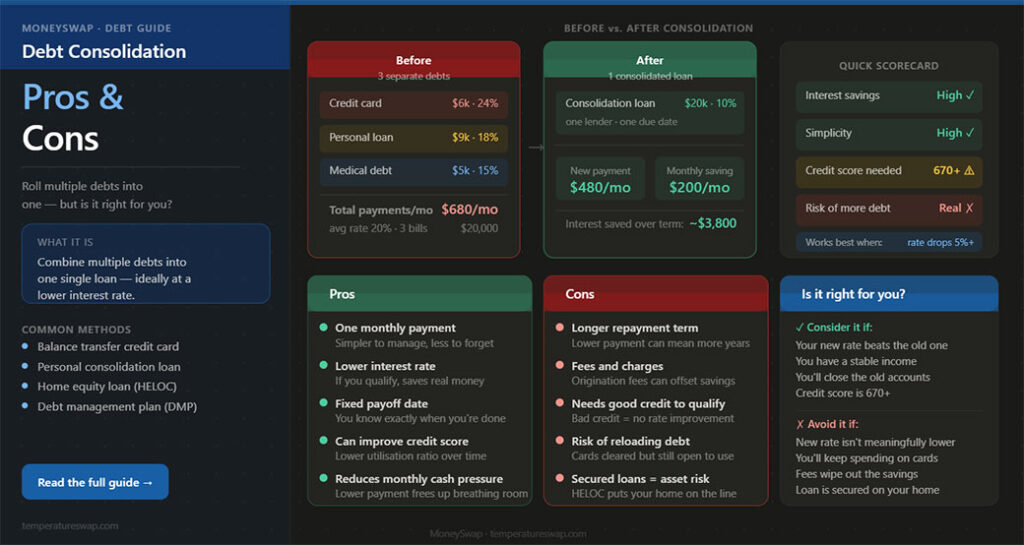
Debt Consolidation At A Glance
Debt consolidation means combining multiple debts into one new account. Most often, you do this with a personal loan, a balance transfer credit card, a home equity product, or a debt management plan through a credit counseling agency.
The goal is usually one or more of these:
- lower your interest rate
- reduce your monthly payment
- simplify repayment into one bill
- set a fixed payoff date
Here’s the short version of how it works. You take out a new loan or line of credit, then use it to pay off existing debts such as credit cards, medical bills, or other unsecured balances. After that, you repay the new account under its terms.
Debt consolidation is not the same as debt settlement or bankruptcy. Consolidation does not erase what you owe. You still repay the full balance, unless you’re using a different program with negotiated reductions.
A quick comparison helps:
| Option | What it does | Best fit | Main risk |
|---|---|---|---|
| Personal loan | Replaces several debts with one fixed loan | Good credit, steady income | Fees or higher total interest over time |
| Balance transfer card | Moves card balances to a low intro APR card | Strong credit, fast payoff plan | Rate jumps after promo period |
| Home equity loan or HELOC | Uses home equity to pay unsecured debt | Homeowners with equity | Your home is on the line |
| Debt management plan | Agency helps structure one monthly payment | Need help with high card APRs | Plan fees and account closures |
If you’re researching debt consolidation pros & cons, start with one basic question. Will this lower your total cost and help you get out of debt faster, or will it only make the payment feel easier while the debt lasts longer?
How Debt Consolidation Is Evaluated
You should evaluate debt consolidation the same way a careful lender or financial counselor would. Focus on math first. Convenience matters, but cost matters more.
The key numbers to review
Check these five items before anything else:
- APR. Compare the annual percentage rate on the new loan with the weighted average rate on your current debts.
- Fees. Look for origination fees, balance transfer fees, annual fees, late fees, and prepayment penalties.
- Repayment term. A lower monthly payment often comes from stretching debt over more months.
- Total repayment cost. Add every payment and fee together.
- Monthly cash flow. Make sure the payment fits your budget without relying on new credit.
Credit impact matters too
Debt consolidation can help or hurt your credit depending on what you do next. A new loan creates a hard inquiry and lowers the average age of your accounts. Yet paying off revolving card balances can reduce your credit utilization ratio, which often helps your score over time.
For example, if you carry $12,000 across cards with a $15,000 total limit, your utilization is 80 percent. If a consolidation loan pays those cards off and you keep them open, utilization drops fast. That often improves your profile.
Behavior is part of the review
This part gets ignored too often. If you consolidate debt but keep spending on cleared credit cards, you risk ending up with both the new loan and new card balances. At that point, debt consolidation pros & cons shift in the wrong direction.
A good evaluation asks three direct questions:
- Are you done adding new debt?
- Do you have room in your budget for the payment every month?
- Will the new loan reduce total cost, not only monthly pressure?
If the answer to any of those is no, pause before moving forward.
The Main Benefits Of Debt Consolidation
Debt consolidation has real benefits when the numbers work and your budget is stable.
One payment is easier to manage
Keeping track of five due dates is harder than tracking one. Consolidation reduces the chance of missed payments and late fees. If your main problem is disorganization, this alone helps.
You might lower your interest rate
This is one of the biggest reasons people choose debt consolidation. Credit card APRs often sit well above personal loan rates for borrowers with decent credit. Federal Reserve data has shown average credit card rates staying high in recent years, often above 20 percent, while many personal loans land lower for qualified applicants. A lower rate means more of your payment goes to principal.
A simple example:
| Scenario | Balance | APR | Term | Approx. monthly payment |
|---|---|---|---|---|
| Credit card debt | $10,000 | 24% | revolving | varies, often high and slow to repay |
| Consolidation loan | $10,000 | 11% | 48 months | around $258 |
The exact payment changes by lender and fees, but the gap shows why debt consolidation pros & cons often depend on APR.
You get a fixed payoff date
Credit cards can keep you in debt for years if you make only minimum payments. A fixed loan gives you an end date. That structure helps many people stick with repayment.
Monthly payments may drop
A lower payment frees cash for essentials or emergency savings. That helps if high minimum payments are choking your budget. Still, lower payments help only if total cost doesn’t rise too much.
Stress often goes down
Debt feels harder when bills come from every direction. Consolidation can make your situation feel more manageable. And when a plan feels manageable, you’re more likely to follow through.
The Biggest Drawbacks And Risks
The downsides matter as much as the benefits. In some cases, they matter more.
You might pay more over time
A lower monthly payment often comes from a longer term. Even with a lower rate, extra months of payments can increase total interest.
For example, moving short term card payoff plans into a five or seven year loan might ease pressure now but raise your total cost. Always compare total repayment, not only the monthly number.
Fees can wipe out savings
Some personal loans charge origination fees from 1 percent to 10 percent. Balance transfer cards often charge 3 percent to 5 percent of the amount moved. If the savings from a lower APR are small, these fees can cancel them.
Good rates usually require good credit
This is one of the most important debt consolidation pros & cons for real borrowers. If your credit score is weak, the loan offers you get might not improve your situation. Some borrowers end up with rates close to their card APRs, which defeats the point.
Secured options add serious risk
If you use a home equity loan or HELOC to consolidate credit card debt, you convert unsecured debt into secured debt. Miss payments, and you put your home at risk. The lower rate looks attractive, but the stakes are much higher.
You can run balances back up
This is the classic failure point. Your cards are paid off, your limits are open, and spending starts again. Soon you owe on the consolidation loan and on the cards. Without a spending plan, debt consolidation becomes debt reshuffling.
Some answers close accounts
Debt management plans often require you to close credit cards. That can reduce your access to credit and affect your score in the short term. For some people, that tradeoff is fine. For others, it creates new problems.
So when you review debt consolidation pros & cons, treat behavior risk as a core factor, not a side note.
How Debt Consolidation Compares To Other Debt Relief Options
Debt consolidation is only one way to deal with unsecured debt. You should compare it with the main alternatives before choosing a path.
Debt consolidation vs. debt management plans
A debt management plan, usually offered by a nonprofit credit counseling agency, combines your card payments into one monthly payment. The agency may negotiate lower rates with creditors.
Best for:
- people with high credit card APRs
- borrowers who need structure and counseling
- those who don’t qualify for low rate consolidation loans
Tradeoff:
- plan fees
- card accounts often get closed
- less flexibility than a regular loan
Debt consolidation vs. debt settlement
Debt settlement aims to reduce the amount you owe by negotiating with creditors, often after you’ve fallen behind. This can damage your credit, trigger fees, and create tax issues if forgiven debt is treated as income.
Best for:
- severe hardship
- people already delinquent and unable to repay in full
Tradeoff:
- major credit damage
- collection pressure during the process
- no guarantee creditors will settle
Debt consolidation vs. bankruptcy
Bankruptcy is a legal process, not a budgeting tool. Chapter 7 can discharge many unsecured debts if you qualify. Chapter 13 sets a court supervised repayment plan.
Best for:
- debt burdens you cannot realistically repay
- people facing lawsuits, wage garnishment, or deep insolvency
Tradeoff:
- serious credit impact
- legal costs
- public record
Side by side view
| Option | Main goal | Credit impact | Cost structure | Best for |
|---|---|---|---|---|
| Debt consolidation | Repay in full with simpler terms | Mixed, often improves over time if managed well | Interest plus fees | Stable income, fair to good credit |
| Debt management plan | Lower card rates through counseling | Mixed | Monthly plan fee | Need structure, high APR cards |
| Debt settlement | Pay less than full balance | Usually severe negative impact | Fees, possible taxes | Major hardship |
| Bankruptcy | Legal relief from unpayable debt | Severe impact | Court and attorney costs | Deep financial distress |
If you still have the income to repay what you owe, debt consolidation often sits in the middle. Less harmful than settlement or bankruptcy, but not always better than a debt management plan.
Who Debt Consolidation Makes Sense For
Debt consolidation is not for everyone. It tends to work best for a exact type of borrower.
Good fit
Debt consolidation often makes sense if most of these points describe you:
- you have multiple high interest debts, often credit cards
- your credit is good enough to qualify for a lower APR
- your income is steady
- you want one payment and a fixed payoff date
- you’ve stopped adding to your balances
- you have a basic budget and emergency plan
A common strong case looks like this. You owe $15,000 across four credit cards at rates between 22 percent and 29 percent, qualify for a personal loan at 10 percent to 13 percent with a three to five year term. You close or freeze the cards you tend to overspend on. In that case, debt consolidation pros & cons usually lean in your favor.
Weak fit
Debt consolidation often makes less sense if these points describe you:
- your credit score is too low for better rates
- your debt problem comes from ongoing overspending
- your income changes a lot month to month
- you’re already missing many payments
- the new loan extends debt far past what you can tolerate
- fees wipe out most of the rate savings
Questions to ask yourself
Before you apply, ask:
- What is the total amount I’ll repay under the new loan?
- Will I stop using the paid off cards?
- Is this solving debt, or only delaying pressure?
- Would a nonprofit credit counseling review give me a better option?
If your answers are clear and your math checks out, debt consolidation can be a useful tool. If not, another debt relief path may fit better.
Final Verdict On Debt Consolidation
Debt consolidation pros & cons come down to one test. Does the new plan reduce your total borrowing cost and help you repay debt with less risk?
When you qualify for a meaningfully lower rate, keep fees low, and avoid new balances, debt consolidation can be a smart move. You get one payment, a clear end date, and a simpler path out of debt. On the other hand, if the term is too long, the fees are high, or your spending is still off track, consolidation can leave you paying more while feeling only temporary relief.
Your best next step is simple. Compare APR, fees, monthly payment, and total repayment across at least three options. Then compare those results with a debt management plan from a reputable nonprofit counseling agency. If the numbers improve and your habits support the plan, debt consolidation is often worth considering. If they don’t, skip it and choose a debt solution that matches your reality.
Frequently Asked Questions About Debt Consolidation Pros & Cons
What is debt consolidation and how does it work?
Debt consolidation combines multiple debts into one new account, typically using a personal loan, balance transfer card, home equity product, or debt management plan. It simplifies repayment by rolling balances into a single payment with the goal of lowering interest, reducing monthly payments, or setting a fixed payoff date.
What are the main benefits of debt consolidation?
Debt consolidation can lower your interest rate, reduce monthly payments, simplify finances by combining payments, and establish a fixed payoff date, all of which may reduce stress and help you manage repayment more effectively if done correctly.
What are the risks or drawbacks of consolidating debt?
Potential downsides include paying more interest over a longer term, fees that can negate savings, higher rates if credit is weak, risk of losing your home with secured loans, and the possibility of accumulating new debt if spending habits don’t change.
How do I know if debt consolidation is right for me?
Debt consolidation fits well if you have multiple high-interest debts, good credit to qualify for lower rates, steady income, and a plan to stop new debt. It’s less ideal if your credit is poor, income fluctuates, or spending habits remain uncontrolled.
How does debt consolidation compare to other debt relief options like debt settlement or bankruptcy?
Debt consolidation aims to repay debts with simpler terms and often less harm to credit, unlike debt settlement which may reduce what you owe but can damage credit. Bankruptcy offers legal relief for unmanageable debt but has a severe credit impact and legal costs.
Can debt consolidation improve my credit score?
Debt consolidation may improve credit if it reduces credit card balances, lowering utilization, and you keep accounts open. However, the new loan can create a hard inquiry and lower average account age initially. Responsible repayment over time often helps credit.
