
From my personal experience, money has a sneaky way of disappearing. You pay rent, grab groceries, cover a few subscriptions, pick up takeout twice, and suddenly your checking account looks thinner than expected. That’s exactly why the 50/30/20 rule appeals to so many people. Instead of tracking 27 tiny categories and feeling bad every time life happens, you give your money three simple jobs.
The idea is straightforward: use about 50% of your take-home pay for needs, 30% for wants, and 20% for savings and debt payoff. That doesn’t mean your real life will fit those percentages perfectly every month, honestly, for a lot of people, especially with high rent, it won’t. But this 50 30 20 budget is still one of the easiest ways to see where your money is going and make better choices without turning budgeting into a second job. If budgeting has felt confusing, this is a good place to start.
What Is the 50/30/20 Rule?
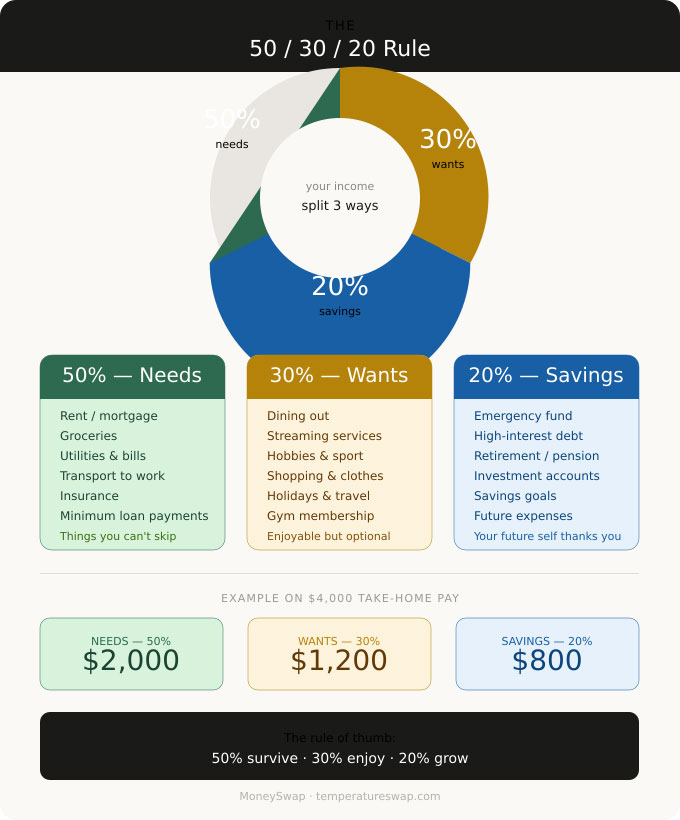
The 50/30/20 rule is a simple budgeting framework that splits your after-tax income into three broad categories:
- 50% for needs
- 30% for wants
- 20% for savings and debt payoff
That’s it. No color-coded spreadsheet required.
What makes the 50/30/20 budget rule so useful is that it gives you a big-picture view of your monthly budget. If you feel like your money vanishes every month, this method helps you quickly spot the problem. Maybe your fixed bills are eating too much of your income. Maybe your “little treats” are doing more damage than you thought. Maybe you’re meaning to save, but nothing is left by the end of the month.
This method is especially helpful for beginners because it’s flexible without being vague. You don’t have to predict every coffee run in advance. You just need to know which bucket each expense belongs in.
One important reality check: the percentages are a guideline, not a moral test. If your rent is high or your income is tight, you may not land neatly at 50/30/20 right away. That doesn’t mean you’re bad at budgeting. It means you’re living in the real industry. The goal is to use the rule to understand your money better, then adjust from there.
Breaking Down Each Category
50%, Needs (the things you can’t skip)
Needs are the expenses you must pay to live, work, and function. Think of these as the bills that would cause a real problem if you stopped paying them.
Common needs include:
- Rent or mortgage
- Basic utilities
- Groceries
- Transportation to work
- Insurance
- Minimum debt payments
- Childcare needed for work
- Basic phone service
This is where people get tripped up on needs vs wants. A need is not “something you use a lot.” A need is something you genuinely can’t skip without serious consequences. So, for example, internet service may be a need if you work from home. But Netflix is not a necessity, even if you watch it every night and quote the shows at dinner.
And yes, this category is often the hardest one to keep near 50%. Rent alone can wreck the math. If your needs are higher than 50%, that’s common, especially in expensive cities. The point is not to feel judged. The point is to know your number.
30%, Wants (the fun stuff)
Wants are the things that make life nicer, easier, or more enjoyable, but aren’t essential for survival or basic work/life responsibilities.
This bucket often includes:
- Dining out
- Streaming services
- Hobbies
- Shopping for fun
- Travel
- Gym extras
- Upgraded phone plans
- Concerts, events, and entertainment
Wants aren’t “bad.” That part gets lost in a lot of budget advice. If every dollar only goes to bills and responsibilities, most people eventually burn out and give up. A 50/30/20 budget builds in room for real life.
Still, be honest here. A want can disguise itself as a need surprisingly well. Daily takeout because you’re tired? Understandable. Still usually a want. The premium version of a service when a cheaper one works? Also a want. That clarity matters, because this is often the easiest category to adjust when your budget feels tight.
20%, Savings and debt payoff
This category is about improving your future, not just surviving the month. It can include:
- Emergency fund contributions
- Extra payments on high-interest debt
- Retirement contributions
- Investing
- Sinking funds for future goals
If you’re unsure what to prioritize, keep it simple:
- Build an emergency fund first so one surprise expense doesn’t go straight on a credit card.
- Then focus on high-interest debt beyond the minimum payments.
- Then put more toward long-term savings and investing, like retirement or other future goals.
That order works well for many beginners because it creates stability first, then reduces expensive debt, then builds wealth. Minimum debt payments belong in needs, but extra debt payoff belongs here in the 20% category.
If 20% sounds impossible right now, start with what you can. Even a small automatic transfer counts. Progress is still progress.
A Real-World Example of the 50/30/20 Rule in Action
Let’s make this concrete.
Jamie brings home $3,500 per month after taxes. Using the 50/30/20 rule, Jamie’s target amounts look like this:
- Needs (50%): $1,750
- Wants (30%): $1,050
- Savings and debt payoff (20%): $700
Now let’s break that into actual spending.
Needs, $1,750
- Rent: $1,200
- Utilities: $150
- Groceries: $300
- Gas and transit: $80
- Car insurance: $70
- Minimum credit card payment: $50
Wants, $1,050
- Dining out: $250
- Streaming services: $40
- Gym membership: $60
- Shopping/fun money: $200
- Weekend outings: $150
- Travel fund: $150
- Miscellaneous extras: $200
Savings and debt payoff, $700
- Emergency fund: $300
- Extra credit card payment: $250
- Roth IRA contribution: $150
That’s a clean example, but real life is usually messier. Maybe Jamie has a month with a car repair and has to cut back on wants. Maybe utilities jump in summer. Maybe the emergency fund gets funded faster, so later more money goes toward debt or investing.
What matters is that Jamie can now see exactly where the money is going. That’s the power of a beginner budget like this. Instead of guessing, Jamie has a plan.
And if Jamie’s rent were $1,500 instead of $1,200? The budget would get tighter fast. Which is exactly why many people need to treat this rule as a starting point, not a rigid pass/fail system.
What If My Numbers Don’t Fit the Rule?
If your budget doesn’t neatly fit 50/30/20, you are very normal.
High housing costs, childcare, medical expenses, debt, and uneven income can all push your needs above 50%. That doesn’t mean the 50/30/20 budget failed. It means your current numbers need a more realistic version of the rule.
Start by figuring out where the mismatch is. If needs are at 65%, the answer usually isn’t “try harder.” It’s “make exact adjustments.” Here are three practical ones:
- Trim the wants category on purpose, not emotionally. Pick two or three cuts that free up real money, maybe fewer delivery orders, one less subscription bundle, or a temporary pause on shopping. Random guilt doesn’t help: targeted cuts do.
- Look for ways to lower fixed costs. This is harder, but it has a bigger payoff. That might mean getting quotes on insurance, refinancing a loan, taking on a roommate, negotiating internet or phone service, or moving when your lease ends if that’s realistic.
- Use a modified ratio for now. Maybe your life looks more like 60/20/20 or 55/15/30. That’s okay. A workable budget beats a perfect one you quit after six days.
If you can’t hit the full 20% for savings and debt payoff yet, don’t do nothing. Build a small emergency buffer first, something modest but real, then tackle high-interest debt as aggressively as your budget allows.
The goal of how to budget isn’t to force your life into a neat formula. It’s to make intentional decisions with the money you actually have.
50/30/20 vs Other Budgeting Methods
There’s no single best budgeting method for everyone, but the 50/30/20 rule is often the easiest place to begin.
Zero-based budgeting gives every dollar a job before the month starts. It can be powerful, especially if you want tight control, but it takes more time and attention than many beginners want.
Envelope budgeting sets spending limits for categories, traditionally using cash. It’s great for controlling overspending in areas like food or entertainment, but it can feel fiddly if you prefer digital banking.
Pay-yourself-first budgeting focuses on automatically saving before you spend anything else. It’s simple and effective, though it doesn’t always help you clearly sort out needs vs wants.
Compared with those budgeting methods, the 50/30/20 rule is the easiest beginner starting point because it’s simple, flexible, and fast to set up. You get enough structure to make better decisions without feeling like your whole life is now a spreadsheet.
How to Start the 50/30/20 Budget Today (Step by Step)
1. Find your take-home pay.
Start with the amount that actually hits your bank account each month after taxes and payroll deductions. If your income varies, use a lower average from the last few months so your budget is safer and more realistic.
2. Calculate your three target amounts.
Multiply your monthly take-home pay by 50%, 30%, and 20%. These numbers give you a starting framework for your needs, wants, and savings and debt payoff.
3. Sort your current spending into the three buckets.
Review your bank and credit card transactions from the last month or two. Label each expense honestly. This is where you catch things like treating subscription services, convenience spending, or frequent takeout as essentials when they really belong in wants.
4. Make a few practical adjustments.
If one category is too high, choose exact changes. Reduce a couple of wants, cap a flexible spending area, or redirect money toward your top priority in the 20% bucket, emergency fund first, then high-interest debt, then long-term savings.
5. Review monthly.
Your budget should be checked and tweaked every month, not set once and forgotten. Bills change, income changes, and life definitely changes, so a quick monthly review keeps your 50/30/20 budget useful instead of theoretical.
Key Takeaways
The 50/30/20 rule works because it simplifies money decisions into three clear categories. For a lot of people, that alone is a huge relief.
A few points matter most:
- Use take-home pay, not gross income.
- Be honest about needs vs wants.
- Treat the percentages as targets, not perfection tests.
- Prioritize the 20% bucket in this order: emergency fund, high-interest debt, then long-term savings/investing.
- If your needs are above 50%, adjust the rule to fit reality and make targeted changes.
You do not need to budget perfectly for this to help. You just need enough clarity to stop wondering where your money went and start telling it where to go.
And if you want a little more structure after this, a full step-by-step budgeting guide can help you build a system that fits your real life. Start small, keep it honest, and let the plan get better as you go.
Frequently Asked Questions about the 50/30/20 Rule
What is the 50/30/20 rule in budgeting?
The 50/30/20 rule is a simple budgeting method that divides your after-tax income into three categories: 50% for needs, 30% for wants, and 20% for savings and debt repayment, helping you manage money with ease and clarity.
How do I classify expenses as needs or wants under the 50/30/20 rule?
Needs are essential expenses you can’t skip, like rent, utilities, groceries, and minimum debt payments. Wants are non-essentials that improve life’s enjoyment, such as dining out, entertainment, and shopping for fun. Being honest about these categories is key.
What should I do if my expenses don’t fit neatly into the 50/30/20 percentages?
It’s normal to deviate from 50/30/20. If needs exceed 50%, try targeted cuts in wants, reduce fixed costs, or use a modified ratio like 60/20/20. The goal is a workable budget that fits your life, not a perfect formula.
Can the 50/30/20 rule help me save if my income is limited?
Yes, the rule encourages starting with small savings, like building an emergency fund first, then paying down high-interest debt, and gradually increasing contributions as your budget allows. Even automatic small transfers count toward progress.
How does the 50/30/20 rule compare to other budgeting methods?
The 50/30/20 rule is simpler and more flexible than methods like zero-based, envelope, or pay-yourself-first budgeting, making it ideal for beginners needing structure without overwhelming detail or rigid planning.
What are the first steps to start budgeting with the 50/30/20 rule?
Begin by calculating your take-home pay, then allocate 50%, 30%, and 20% to needs, wants, and savings/debt respectively. Review your recent expenses to categorize them honestly, then adjust spending and review your budget monthly to stay on track.
